Schools need a simple and trustworthy way to know who is on campus and when they arrived. Many campuses still rely on clipboards or a single tablet at the office. Handwritten names are often illegible and there is no easy way to tie a person to a particular day and time. Static QR codes posted on walls can be photographed and reused later, which means “check-ins” can happen off-site. When a check-in kiosk or Wi-Fi goes down, lines build and the recordkeeping stops altogether. Data also ends up fragmented. Parent meetings are in one system, volunteer hours are in another, and contractors are not captured at all. As a result, reconciliations are slow and error-prone. This can create significant problems with state reporting or audits.
Many districts have paid substantial sums for services that later proved unverified or fabricated. In Texas, the owners of tutoring companies serving Dallas and Fort Worth were sentenced after prosecutors showed they invoiced roughly $3.1 million for sessions based on forged sign-in sheets. In a multistate scheme, a father–son team created invoices from false attendance records in more than one hundred school districts before they were convicted. The common thread in these cases (and many others) is unreliable proof of presence.
When a person arrives at a school, the individual taps their cellphone to a TapPoint. TapIn sends a one-time URL to complete a short check-in. Every interaction is time-stamped and location-stamped, using the TapPoint ID. The process is cryptographically signed and produces an audit-ready record. Because the TapPoint can stay in a pocket, on a lanyard, or on top of a desk, schools can bring the “kiosk” to the car line or directly into a classroom without needing a powered station or network.
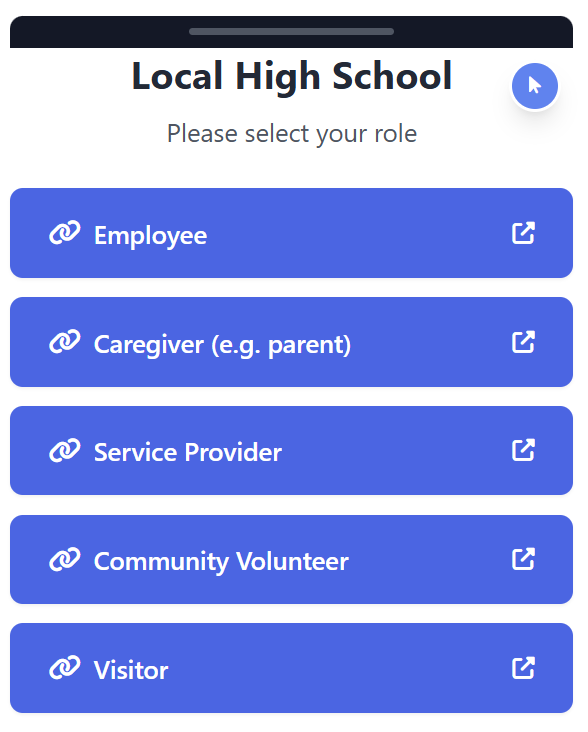
The TapIn experience prompts the individual to identify their role. An employee can clock in for the day. A caregiver can identify the student and choose the reason for the visit. A service provider records the organization and the student or class they will serve. Finally, volunteers can identify their assignment and supervising staff. A live dashboard shows who just arrived, their role, and their intended destination. At any time, administrators can export a complete trail of who, when, where, and why.
Each tap issues a single-use session that expires quickly, which prevents link sharing and “checking in from home.” Because the check-in begins with physical presence at a specific TapPoint in staff custody, the process resists most of the failure modes common to paper logs and static QR codes. There is no public kiosk surface to tamper with, and TapIn remains functional even when building power or Wi-Fi is unavailable. These properties ensure that outages do not erase your audit trail and that every record reflects a real, in-person interaction.
TapIn turns every doorway, desk, and hallway into a portable, verifiable check-in point and provides an audit trail schools can trust.
Here at TapIn, our mission is to effortlessly connect people. Contact us to learn more or share your thoughts.

© 2026 Tapin Solutions Inc. All Rights Reserved